
Vibrant Days….
Flourishing with Sensory Processing Sensitivity
March 2016
Workshop: Thriving as a Highly Sensitive Person
Ted Zeff, Ph.D. and Candy Crawford, L.C.S.W. will present valuable, new information to help HSPs thrive in our over-stimulating world.
Candy Crawford’s talk is “HSP’s in Relationships: The Arduous, The Agonizing, and The Amazing”
Dr. Ted Zeff’s talk is “Thriving as an HSP.” He will discuss methods to calm the senses when over-stimulated, the best diet and exercise for HSPs, coping with stress at work and how to create a new stress-free job. There will be a question and answer period where you will be able to ask any personal questions about thriving as an HSP.
Workshop Details:
When: Saturday, April 9th, 2016 from 10am to 1pm
Where: Loretto Center 1600 Somerset Lane, Wheaton, IL
Cost: $55 (cash or check)
To Register:
- There are a limited number of spaces available at the workshop. To guarantee a space, please email Ted Zeff at tedzeff108@gmail.com with your name, email address, home address and phone number.
- One you have received your email reservation, you will be registered for the workshop.
- Please let us know 3 days in advance if you will not be able to attend the workshop so that people on the waiting list will be able to attend.
- Snacks, coffee and tea will be provided!
Candy Crawford L.C.S.W. has a private practice in Wheaton specializing in high sensitivity. Candy lives with her husband and two sensitive teenage daughters and a “variety of pets.” She loves reading, music and being outside whenever possible.
Ted Zeff, Ph.D is the author of The Highly Sensitive Person’s Survival Guide, The Highly Sensitive Person’s Companion, The Strong Sensitive Boy, and The Power of Sensitivity. Elaine Aron, Ph.D., author of The Highly Sensitive Person, has written the foreward to his books. Dr. Zeff’s books have sold more than 75,000 copies and have been translated into 7 languages. He has more than 25 years experience counseling sensitive children and adults.
Dr. Zeff currently teaches workshops and consults internationally on coping strategies for highly sensitive children and adults. He has given presentations in Denmark, Holland, Norway, Israel, and throughout the United States. He has been interviewed about the trait of high sensitivity in the media, such as NBC TV, PBS radio, Psychology Today and the Huffington Post (which received 1.2 million likes).
Relate
The Joy in Breaking Open – by Marty Miller
There is a joy in breaking open. For me, it came after a great season of personal losses. I fumbled for a long time in darkness learning to feel my own pain, and  much later to boldly claim it and follow its contours lovingly with my own hands until I knew its shape. My soul had left tracks in the underworld and in numinous encounters with wild things in the day world. I vowed to follow wherever those tracks might lead me.
Recently I followed a trail to British Columbia where, sitting under the stars, I traded stories with a group of like-minded souls late into the night. There, a lovely young potter from Seattle told us about her art: the subtle skills needed to throw and shape clay, the intricacies of creating and applying glazes, and the thoughtful pause that would catch her before she placed each lovingly and tenderly crafted pot in the kiln and surrendered it to a night of ravishment by fire. When she spoke about opening the  kiln door in the morning and often finding a pot broken and lying in pieces on the kiln floor, a hint of a smile crossed her face. Some sweetness passed between us for a moment. We each smiled in turn as we contemplated the tiny crack or imperfection in the material that, under intense heat, can so abruptly shatter such careful work. In that moment, we felt the joy of spirit released from clay.
Some pots are only made to hold a brief lesson in impermanence. 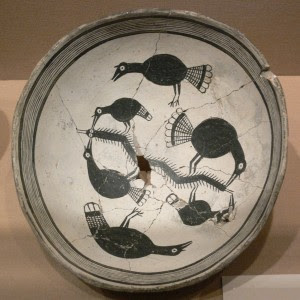 Others withstand the fire to protect and contain that which we value for decades. And yet the spirits of the things inside eventually yearn to be released into a larger world to fulfill their purpose; the wine wants to be drunk, the lamp oil to give light, the seeds to sink into the earth and burst forth as green flames. Linda Hogan recounts in her book Dwellings how the ancient Mimbres people of New Mexico mysteriously vanished from history. Before doing so, it is believed that they intentionally broke a small hole into each of their clay pots, a “kill hole”, thought to allow the spirit of the vessel itself to move freely and follow them in this world and beyond.
I shared with the table a lovely Hasidic story of a rabbi who always told his people that if they studied the Torah, it would put Scripture on their hearts. One of them asked, “Why on our hearts, and not in them?” The rabbi answered, “Only God can put Scripture inside. But reading sacred text can put it on your heart, and then when your hearts break, the holy words will fall inside.”
My “sacred texts” are known to many of you: Rumi’s poems of longing for his Beloved; Rilke’s fierce declarations of love and faith in a dark god; and Bly’s wondrous leaps to places where a moose “Has risen out of the lake, and he’s carrying on his antlers / A child of your own whom you have never seen.” I placed these holy longings on the clay vessel surrounding my heart, increasingly aware of how constricted my life, my job, and so many of my relationships had become. At times I felt the momentary terror and delight of cracks forming. Yet I held firm to the worn-thin protections of my childhood. I became increasingly separated from the source of my vitality, from a soulful life. I entered a dark time.
Three years ago my long career as a technology manager at a large financial services company came to a bitter end through a series of professional and self-betrayals. I had stayed too long in a role that had long ceased to serve me. And I was no longer serving others the way I wanted to serve. Around the same time my father contracted prostate cancer that spread quickly through his bones. He was put on chemotherapy treatments to keep the cancer from “jumping” to his soft tissues. With a suppressed immune system, he contracted pneumonia and was hospitalized. His kidneys began to fail. I was in the room holding his hand when the doctor gave him the prognosis of “weeks, not months.” Not long afterwards Barry, my best friend of nearly 30 years, killed himself in a moment of blinding grief over the death of his wife.
I drove the three hundred miles to the hospice and back nearly every other week. Dad slowly stabilized after a few months of care. We had never been very close but something opened between us during those visits. One afternoon we were sitting together in silence. I thought he had dozed off. He opened his eyes and asked, “Do you believe in God?”
The topic of religion and the sacred was fraught territory and a subject of bitter debate between us in my youth. But something impelled me to say to him, in that unguarded moment of intimacy, “I do not know if I believe the same way you do. I can say I feel closer to Mystery or the Divine when I am in wild places of natural beauty. I feel the deepest sense of belonging there like everything is speaking to me.” He paused for a moment. “Yes, me too.”
He told me that he felt closest to God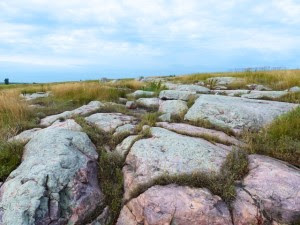 as a young cowboy tending cattle in South Dakota and told me of a specific image. “I was up on a hill on horseback. The sky was wide open and blue with just a few puffy clouds floating by. I was watching a cow giving birth on the plain below, watching the prairie grasses move in long waves, and a Red-tailed Hawk was hovering above me on the current coming off the bluff. I thought, ‘This is about as close to heaven as I will come on earth.'”
As my father’s condition moderately improved, he moved from the hospice facility to hospice care at home where he was lovingly tended by my mother and nurses. In between visits I began to spend more time in the local woods and prairies near my home and hiked for days at a stretch on the North Shore of Lake Superior. I delved more deeply into the natural history and the phenology (tracking cyclic and seasonal plant and animal phenomena) of the area. And I sat at the foot of a Pin Oak near my home every day listening to birds, watching the light through the leaves, attentive to each new sprout, song, or bloom.
I rekindled my longtime interest in animal tracking and began ho sting a monthly class by the confluence of the Minnesota and Mississippi Rivers. I noticed, too, how the art of tracking was changing for me. My fellow trackers were learning to track in a pattern that was familiar to me. Their ways of knowing and interacting with wild animal tracks and sign moved from thinking to sensing, to feeling, and then to deep imagining.
As I had, they would nearly always begin by tracking clearly defined prints in mud or sand and counting toes, and consulting field guides for a species name. They would think of tracks rationally as a problem to solve with their heads. Most would then move to lightly touching the tracks, moving their bodies around the periphery to see them from different angles, often imitating the gait of the animal whose tracks they saw before them, involving more of the senses. Some would stop to smell a hint of fox urine. Some were also listening more closely to the sounds of birds along a wide radius and could begin to make out a chain of alarms signaling a fox moving away through the underbrush.
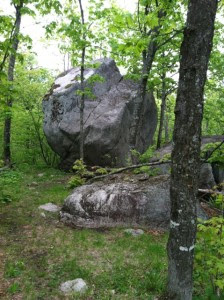 Listening at my spot under the oak, or out in the field with a group, I noticed sensing giving way to feeling. When a Cooper’s hawk would fly within a 100-yard radius, I could feel the sudden oppressive silence as a compression of my chest. I learned to move more slowly, with a quiet mind, and see how my approach was reflected in the way the birds responded to me. The more I could quiet my mind the less disturbance I would make in the forest.
At some point an awareness dawned that everything in the forest already knows I am here. What fiction had I been living that made me the only subject and everything else a willing object of my attentions? Now I began to feel in my heart that the whole forest was in conversation. I had been deaf and was only beginning to hear. I was mute; I was not yet speaking to the plants, animals, birds, and insects. But I had the gnawing conscience that I was a now reluctant member of, as David Abram says, “a single species only talking to itself.” I had been caught up in the Big Lie of our western industrialized culture: that the world is made for humans and humans are made to rule it. I began to see the forest and its creatures differently, with the “intelligence of the heart” as James Hillman describes it. He wrote:
“All things show faces, the world not only a coded signature to be read for meaning, but a physiognomy to be faced. As expressive forms, things speak; they show the shape they are in. They announce themselves, bear witness to their presence: “Look, here we are.” They regard us beyond how we may regard them, our perspectives, what we intend with them, and how we dispose of them. This imaginative claim on attention bespeaks a world ensouled.”
In Dad’s last few weeks, I would sit at his bedside and hold his once powerful and now weak and ashen hand in mine. We talked candidly about how he had made peace with his Creator and was ready. I told him about my deepening conversation with the wild things. I told him how I was learning to lead with my heart, to have faith in the truth of my imagination, and how I was beginning to fall deeply in love with life again. He smiled with some bemusement at his dreamer son. We were both vividly aware of the many differences that often separated us from each other. But in those precious moments of silence in his room, the space between us was filled with affection and compassion.
On a sleepless night during one of my last visits with him, I picked up a book in the middle of the night and opened to this passage from Hazrat Inayat Khan: “God breaks the heart again and again and again, until it stays open.”
Last September, my father finally passed away two and a half years beyond his doctor’s prognosis. He and I had shared the gift of spending more time together than we had since I was a boy. We had expressed our love for one another many times. And throughout his last days I witnessed the dignity and strength I had always admired in him.
Days after Dad’s funeral, I came to the 2014 men’s conference, shaky and tender-hearted but feeling a need to be deeply held in community there. I knew my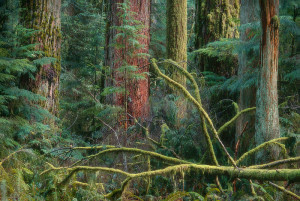 mother was being cared for by my siblings and relatives and that I would be back soon to be with her. At that time, I wanted to grieve in community, to see and be seen by other men. I needed to share my feelings of grief with them and, in turn, be there to witness and tend to their grief. I did not want to be enclosed in the cage of my personal grief any longer. Knowing, as Rumi writes, that grief visits as “a crowd of sorrows, / who violently sweep your house / empty of its furniture…” opened me to fully feeling its passage in my body. I faced and welcomed my sorrows without a sense of shame or personal failing. I took solace in the wider community of red pines, loons, and the solemnity of granite boulders along the lakeshore who each spoke in its own way, as we men had in our most unguarded moments, “Here I am. My presence is my soul speaking.”
Descending through towering firs and cedars on the west coast of Vancouver Island breathing in the first hint of salt spray, I can now see the long beach stretching out be yond a cleft in the hills. I come to a small bulletin board standing at the edge of the beach that warns hikers of bears and mountain lions in the area. I walk ten feet onto the beach and see in the sand the asymmetrical and lobed paw prints of a female mountain lion. I follow the tracks along the beach noticing how her trail zigzags. In my mind’s eye I can see now how she traced the jagged edge of shadows of trees backlit by last night’s rising, waxing moon. Her tracks lead me to a giant grandfather cedar lying weathered on far end of the shore. I sit down on the rocks near him and begin to tell my story. He reminds me a bit of my father and my grandfather before him: quiet, stern, but with the slightest coyote grin at the corners of his mouth. As the sun begins to set, I feel a kinship and a warmth. I tell Grandfather Cedar, “You and I are made of the same stuff”-thinking atoms, molecules, biological ancestors. I feel more than hear his reply-“Yes. Dreams.”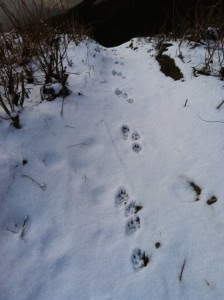
Participate
Action expresses priorities.
-Mahatma Gandhi
It has become common practice for me to consume without acting. Even if what I read, experience, digest is compelling; often I resist the next step: Participation
Participation implies taking some action, contribution, or involvement in what I’ve merely consumed. I’m actually doing it now.
Candy asked me to not only ‘think about’ or ‘digest’ this section of “Participate” in the monthly newsletter; but to DO something. Describe, explain, and introduce it. Here I am. “Doing” something such as searching quotes on “participate,” or “action” and considering what that may mean for HSPs.
Your participation matters and this is the opportunity to share. Participate is simply to feedback to the readers of this newsletter where you are in the journey. What you’re learning, becoming aware of, how new understanding is being realized in your world and in your relationships.
Participating in Vibrant Days is a judgement-free zone where fellow HSPs are able to listen to your experiences. Take that first step of action. Submit your thoughts. Participate.
Watch
Can we make a pact to quit apologizing for expressing our tears? Such beauty is a gift to be experienced and shared.
https://www.youtube.com/watch?v=9FHYBQxURQo
Ponder
The unfed mind devours itself.
– Gore Vidal
In this together,
Candy