
Vibrant Days… Flourishing with Sensory Processing Sensitivity
This came out in Elaine’s newsletter this month. I’m including it since it generated so many thoughts.
The Container and the Contained
Have you ever thought (at any age) that you are getting older but something in you is not? That you are really the same person you have always been?
Have you ever felt like you were witnessing yourself in a situation? That you were not the “doer”?
Who is that person that does not change, and the one that can witness without participating? This is a huge subject, but let’s take on a piece of it.
In the second half of recent newsletter blogs I have been addressing “spiritual” topics, I guess in the classical sense of spiritual as opposed to material, since I began by writing about the possibility of experiencing two aspects to life, the relative and the absolute or transcendent. In the second blog, I simplified matters by talking about expansion and contraction. Even forgetting about anything absolute, we all know that there are expanded and contracted mental states. There is nothing wrong with contracted states. We contract or constrict our awareness when we focus. If you want to speak more philosophically (HSPs usually like to), ultimately, everything in the relative, material world is contracted in the sense it is one aspect of the whole. Being expanded is when we relax those constrictions and see the bigger picture or enjoy some rest.
In this blog post I want to talk about these two aspects of life in a different way, the container and what it contains.
The Contained? What’s That?
As always, I hope to be both factual and practical. By the “container” I mean our body, but we can extend that to everything else in the relative that “belongs to us”–our name, history, education, career, family. All that is ours. But the body is so central, because it at least seems that without a body, especially without a brain, everything else goes. We may forget, ignore, or deny our physical vulnerability until we get seriously sick or are caused to notice that we are aging. (I secretly think there’s something mean about those birthday cards that make jokes of our adding another year.)
I am sure all of you view death and what does or does not remain after death in very different ways. Some of you are already yawning–you totally believe in an afterlife. Maybe reincarnation. But others of you are already annoyed, that I would even bring it up. When we die, everything goes. How is it factual or practical even to discuss it?
The Factual
True, it seems that just as most people only know about the relative and not the absolute field of life, most people only know about the relative container, the body, and completely identify with that. Yet the fact is that a vast number of people think they have a soul or spirit that lives on after death. Some people feel they have experienced it during a near-death experience. The research on these experiences is quite solid and substantial (e.g., the work of Bruce Greyson). Many say they have experienced visitations by a loved one who had died and was able to come back to speak to them or show them some sign of their presence. Further, every single religion (even Judaism) has some idea of the soul or spirit living on, reincarnating into a new body or eternally living in a place where the soul goes after death.
Those are the facts of countless human experiences, and it can be hard to believe that so many are simply wrong–except you and me. I’m saying “you and me” because I’ve never been sure what I believe about all of this. (A friend who is certain about reincarnation teased me that it was my karma to be born with the burden of not believing I would be reincarnated.) One practical part of the container plus contained perspective is that it really does change how you live your life if you are certain that death does not end it.
But forgetting about the question of whether something survives death, some people I really respect have no doubt that the body is the container of something more. Indeed it seems to me that all spiritual teachers and writers have discussed it. For example, I like Thomas Merton on the subject of the “individual,” which our culture relentlessly encourages us to develop, to “self-actualize,” and the “person” God means for us to be, which we can only know when we let go of the outer trappings of ourselves and our lives and seek to do God’s will and to know God’s love.
Then there is Ram Dass, that jolly, charming author of Be Here Now, who had a stroke in his sixties and then wrote Still Here to explore for us the issue of aging and death, using his personal experience.
The Practical
While I am not sure about life after death, like Ram Dass I know about life now. After fifty years of consistent meditation practice and eighty years of living in my body, I have the clear experience of my body being the container of something else, a witness to it all, or the Soul as Ram Dass calls it. This is not a belief, but an experience, and it is extremely practical. The experience can be overwhelmed for a time by something like being in chronic pain, a new scary diagnosis of something, or losing another activity that I once enjoyed. But that “this-is-it” feeling does not last. Without much of an effort, the transcendent–the Soul, the Great Whatever–prevails. I just feel this equanimity return. It is something big, boundless. And I can tell that it is due to my not identifying with my body or its changes very much. I am something else. Again, it is not a belief or attitude. I experienced that. And it certainly makes aging and illness less difficult, so far.
Here’s another practical story: I turned to Ram Dass after reading the transcript of an interview with Riyas Motan on “Buddha at the Gas Pump” (one of my favorite podcasts). Riyas was born in Kenya, of Indian ancestry, and while working as a psychotherapist, privately pursued a spiritual path until he had a permanent “awakening.” This eventually led to his being given “dharma transmission” by one of his spiritual teachers, Adyashanti. This meant he was considered evolved enough to teach others, so in a way it was the pinnacle of his life. But four months later, this very health-conscious, spiritual man learned he had fourth stage, probably terminal lung cancer, and was plunged into the treatment for that.
Adjusting to this extreme change in his life demanded that he use his spiritual life as never before to come to a place of not just acceptance, but growth. After much inner work he says he is actually grateful for the cancer, saying that it “happened not to him, but for him.”
That line really caught my attention. He was quoting Ram Dass, who felt the same about his stroke, which left this dynamic man in a wheelchair and able to speak only very slowly. How does one get to that place of feeling this is the best thing that could have happened to me? Not easily, when you live in a culture that focuses entirely on the body and its health, as if that is all you are. But Ram Dass has a lot to say about undoing that perspective in his Still Here. And it comes down to finding a way to get to know the difference between the container and what it contains. Of course the container, the body, is important. The contained must have a container. But how many of us really know the contained? Really can identify with it?
How to get there is another subject, so complex that it led me to spend five years researching and writing a book about it, Spirituality Through a Highly Sensitive Lens. It will be published next spring, but in the meantime I hope these blogs will give you some ideas. It is always, in the end, a very personal journey to reach a place like that of Thomas Merton, Riyas Motan, or Ram Das. But I wanted to make it clear that it can be done. By anyone.
~Elaine Aron, Ph.D.
4 exciting in-person hsp gatherings!
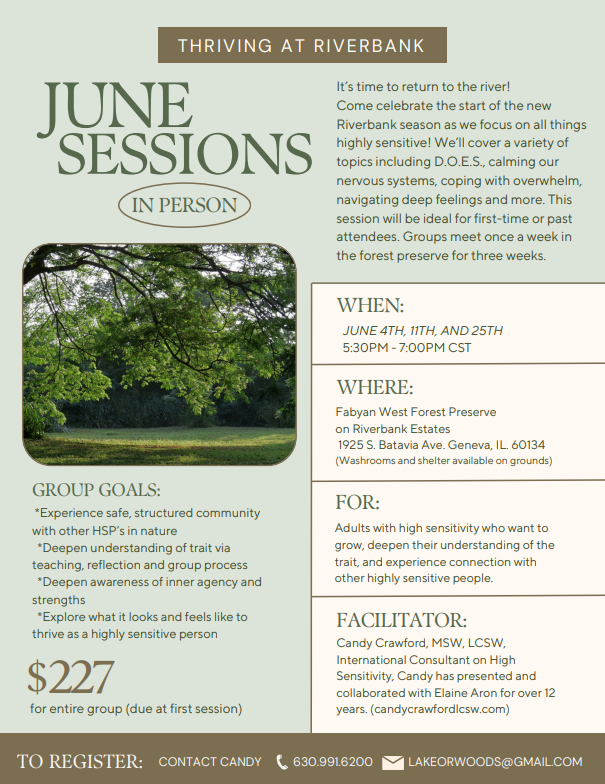
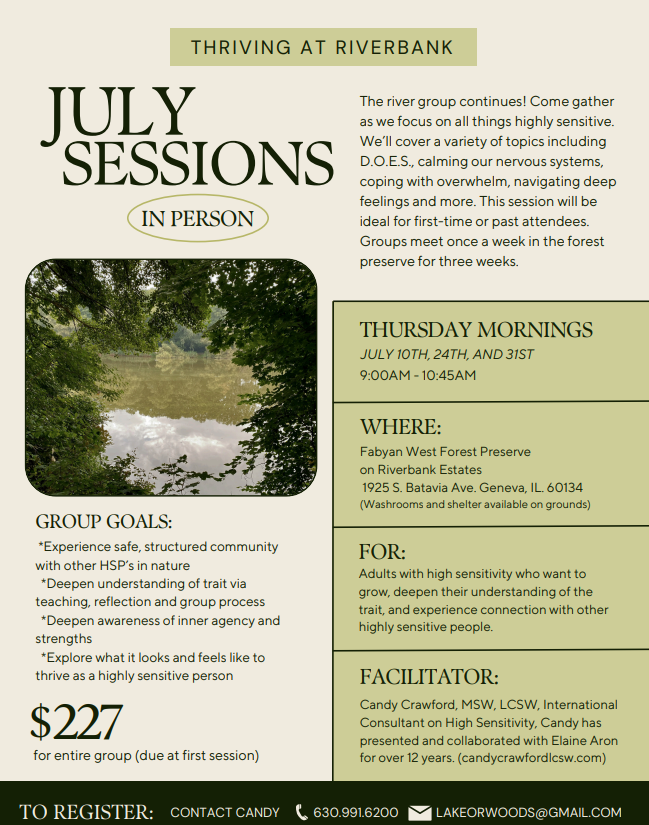
41st HSP Gathering Retreat – August 29 – September 2, 2025 – Boyd Mills Retreat Center (owned by the Highlights Foundation) in the Pocono Mountains of Pennsylvania in Millanville, PA.
Dr. Elaine Aron joins us via Zoom as our special guest speaker presenting: Part I: The Latest HSP Research and Part II: HSPs & Spirituality
Jacquelyn will present The Spiritual Journey to Empowerment for the HSP: a road less travelled. This is the same presentation shared at the 2nd Italian HSP Conference in Bologna, Italy, Oct 2024.
More information, plus photos from past gatherings, and video testimonies can be found on Jacquelyn’s website: https://
Save the Date: Luxury HSP Retreat in Costa Rica.
Click here to hear more about what’s happening. Early bird registration is now open.
Some thoughts and a song from brilliant artist Jon Bellion:
When I write for myself I always try to reach deep into a place that’s almost draining to get to, my North Star rule is always that if I can bring a nugget back from diving deep into myself, the deeper I go to get it the more universal the nugget will be for everyone that I show it to.
This song is from a place inside me so deep I can’t really even begin to explain it. And something about it not solving or providing a concrete answer brings me peace. Knowing that a lot of you will hear this and just … sit with it. And experience what ever emotion comes up for you brings me some sort of joy. It makes me emotional when I know humans are feeling that universal feeling of loneliness or sadness, that feeling we all try to mask and distract ourselves from feeling. We run from asking the questions to our friends and family that will bring us clarity and closeness because even the thought of the pain of addressing them is unbearable for most of us. I wrote WHY and realized this a moment for people to pause and feel what ever they need to feel. And maybe one day you can out loud ask those questions of self worth and purpose to your friends and family and even publicly, but until then, this song will do.
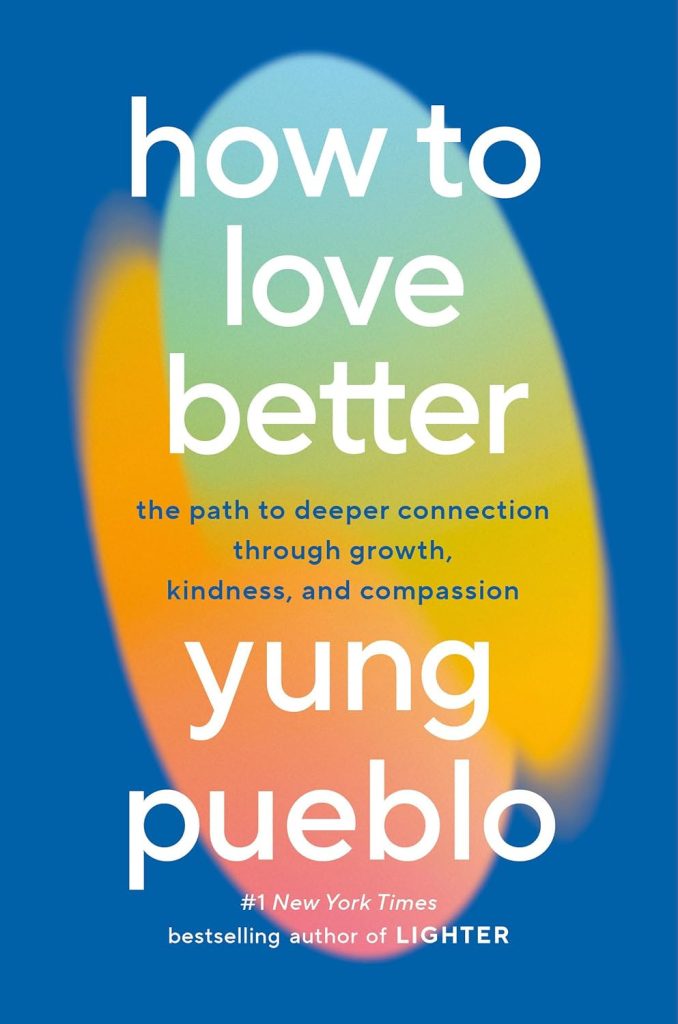
What I’m reading:
What I’m pondering:
